Spain
Santander (Cantabria)
2025
Seawater
2350 m
Scroll down to read the Spanish version
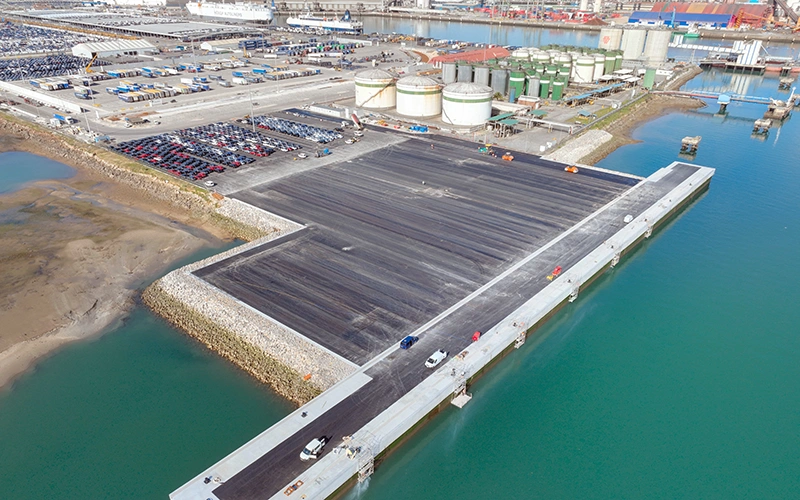
In 2025, the Port Authority of Santander awarded Ferrovial the construction of a new abutment and ramp aimed at improving the operational capacity of Raos 9 quay at the Port of Santander. With an investment of nearly €15 million, the project sought to increase loading and unloading operations and improve the quay’s versatility for ro-ro maritime transport traffic.
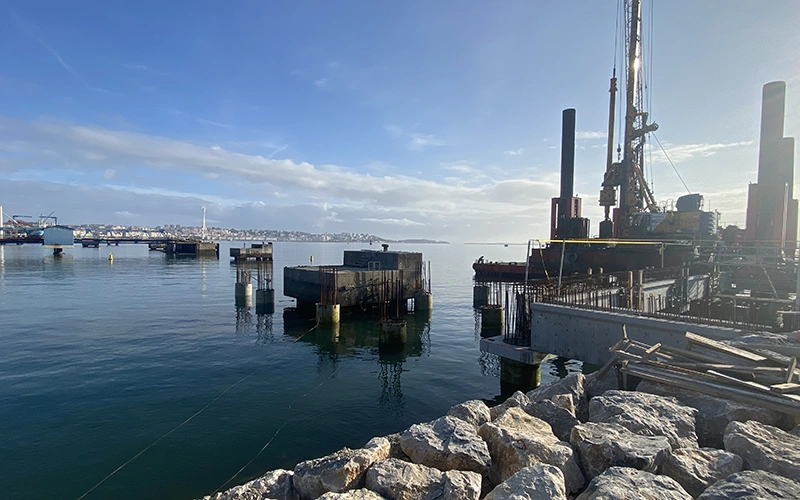
Both infrastructures were completed within a total of 11 months. The ramp – weighing 535 tonnes of steel – consists of a 34 m long and 16 m wide steel bridge rigidly connected to a floating pontoon. Meanwhile, the abutment, consisting of an L-shaped concrete slab (64 m x 75 m), is supported by 2,872 linear metres of piles with a diameter of 1.20 m, 1,560,000 kg of reinforcing steel and 4,900 m³ of concrete.
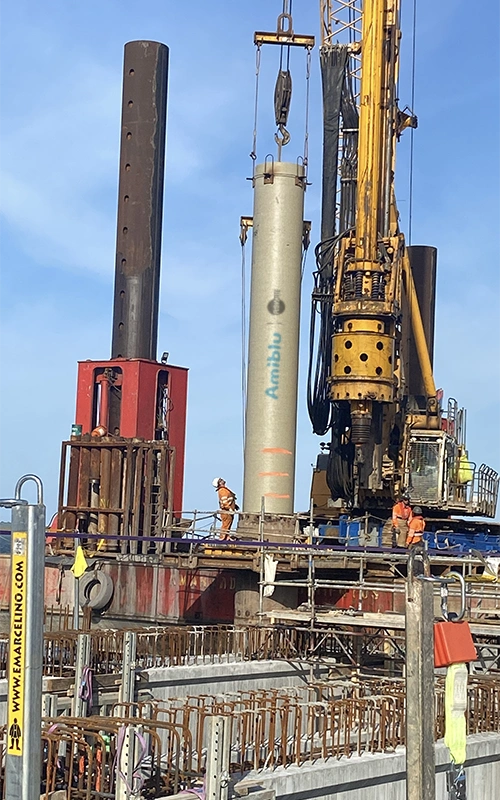
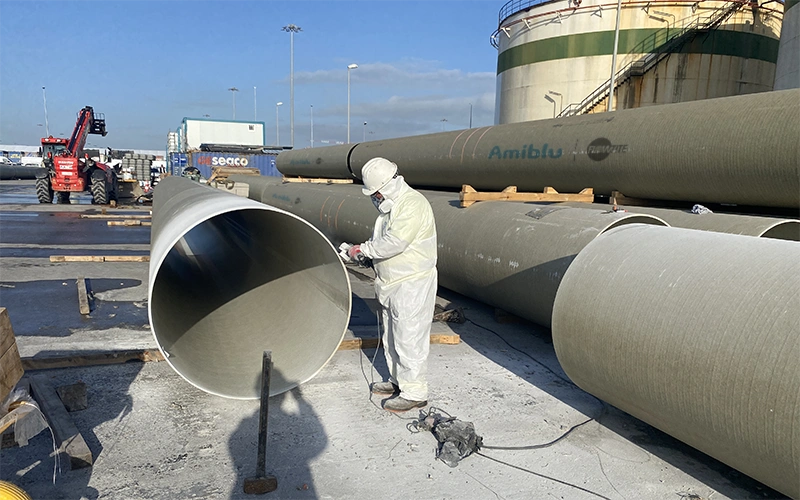
These piles are large-diameter structural elements (DN 1200) driven into the seabed to provide structural stability, withstand wave action and ro-ro traffic loads and, ultimately, ensure the durability of the infrastructure.
In the original design, the piles were specified in steel – properly treated to delay oxidation caused by seawater exposure – but GRP was ultimately selected due to its multiple advantages:
The new ramp and abutment are now fully operational. According to the President of the Government of Cantabria, María José Sáenz de Buruaga, the new infrastructures consolidate the Port of Santander as a “strategic benchmark” on Europe’s Atlantic façade and a “driver of development” for the region:
„The Port of Santander ranks first both in tonnage and in intermodal transport units. The Port is the soul and heart of Cantabria’s productive fabric. A nearby, reliable and competitive port, supported by an excellent port community.”
Amiblu suministra tuberías de PRFV DN 1200 para los pilotes del muelle de Raos 9 del Puerto de Santander.
En 2025, la Autoridad Portuaria de Santander adjudicó a Ferrovial la construcción de un tacón y una nueva rampa para la mejora operativa del muelle de Raos 9 en el Puerto de Santander. Con una inversión cercana a los 15 millones de euros, el objetivo de la obra era aumentar las operaciones de carga y descarga y mejorar la versatilidad del muelle para el tráfico rodado del transporte marítimo.
Ejecutadas ambas infraestructuras en un total de 11 meses, la rampa –de 535 toneladas de acero– está formada por un puente de acero de 34 m de largo y 16 m de ancho, unido rígidamente a un flotador. Por su parte, el tacón, que consiste en un tablero de hormigón con forma de L (64 m x 75 m), está sustentado por 2.872 m lineales de pilotes, de 1,20 m de diámetro, 1.560.000 kg de acero corrugado y 4.900 m3 de hormigón.
Estos pilotes son elementos estructurales de gran diámetro (DN 1200) que se hincan en el subsuelo marino, para dar estabilidad a la estructura, soportar acciones del oleaje y del tráfico rodado (ro-ro) y, en definitiva, asegurar la durabilidad de la obra.
En proyecto, los pilotes estaban diseñados en acero –debidamente tratados para posponer la oxidación provocada por el agua de mar–, pero finalmente se eligió el PRFV por sus múltiples ventajas:
La nueva rampa y el tacón están plenamente operativos. En palabras de la presidenta del Gobierno de Cantabria, María José Sáenz de Buruaga, las nuevas infraestructuras construidas consolidan el Puerto de Santander como un „referente estratégico” de la fachada atlántica europea y „motor de desarrollo” de la Comunidad:
“El Puerto de Santander es el primero tanto en toneladas como en unidades de transporte intermodal. El Puerto es el alma y el corazón del tejido productivo cántabro. Un puerto cercano, fiable, competitivo y dotado de una excelente comunidad portuaria”.
© Amiblu Holding GmbH, 2026
 Visszagörgetés a tetejére