Du bist hier: Startseite1 / Reference2 / Securing Europe’s Energy Future with Advanced GRE Pipeline Technology...

Germany
Brunsbüttel
2025-2026
Cooling and Process Water
4500 m
Amiblu delivers high-performance GRE solutions for Germany’s strategic LNG terminal in Brunsbüttel, combining corrosion-resistant materials, engineered system design, and reliable installation under demanding conditions.
In 2022, the German government accelerated the development of a land-based liquefied natural gas (LNG) import terminal to strengthen national and European energy security. As the first regasification terminal in Germany, the facility enables the country to import gas directly from the sea and inject it into the national network, marking a significant milestone in diversifying energy supply. Located at the mouth of the Elbe River in the North Sea, the terminal is designed as a strategic infrastructure project within Germany’s broader energy transition.
The EPC contract for the terminal was awarded to the consortium CS Gas North, comprising COBRA (VINCI Group) and Sener, acting on behalf of the client German LNG Terminal GmbH. The facility includes two storage tanks with a capacity of 165,000 m³ each and is designed to deliver an initial output of up to 8 billion cubic meters of natural gas per year, with expansion potential to at least 10 BCMA. Within this context, the regasification pipeline system was a central component, requiring a solution capable of delivering long-term reliability under demanding environmental and operational conditions.
Amiblu was selected as the solution provider based on its extensive expertise in glass-reinforced plastics and its advanced GRE (Glass-Reinforced Epoxy) pipe systems. GRE represents a high-performance alternative to conventional materials, especially in corrosive and harsh environments. Combining high-strength glass fibres with a highly heat-resistant epoxy resin matrix, Amiblu GRE pipes offer exceptional mechanical performance, full resistance to internal and external corrosion, and excellent thermal stability. These properties make them ideally suited for complex industrial applications, where long service life, minimal maintenance, and operational reliability are essential.
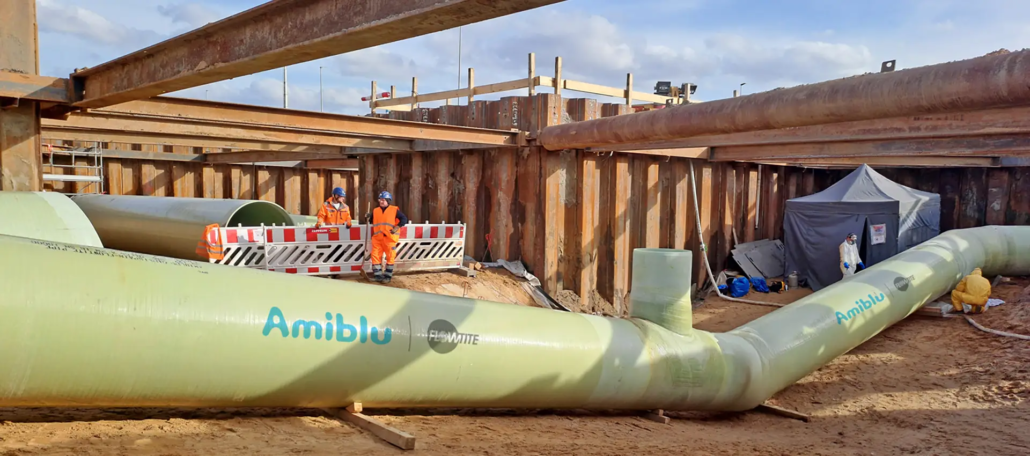
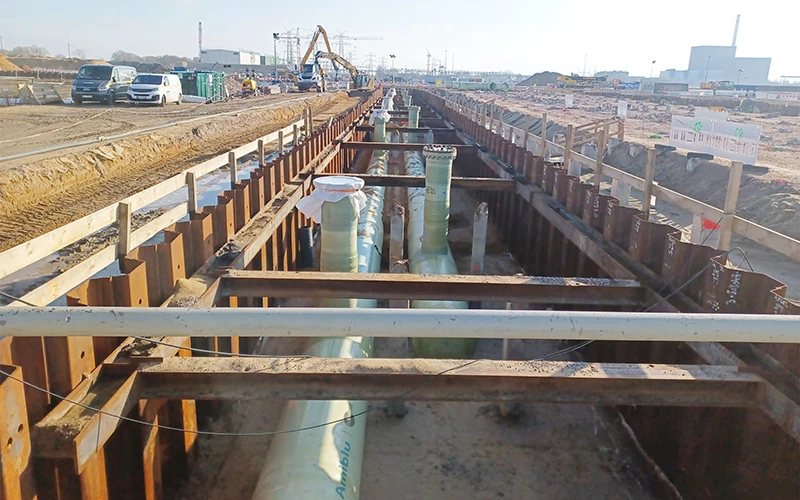
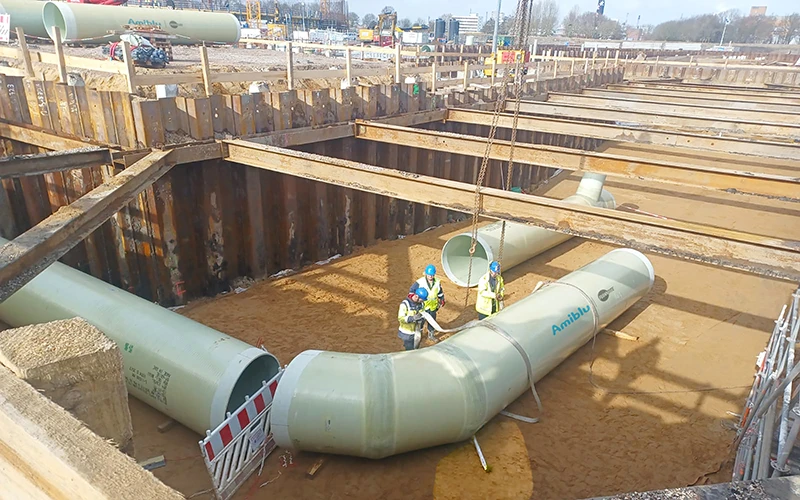
The project scope includes the design and installation of approximately 2.6 kilometres of large-diameter GRE pipelines, reaching dimensions up to DN1600, complemented by around 1.7 kilometres of GRP piping for the firefighting system. The installation covers both underground and above-ground sections, requiring careful coordination and engineering precision.
Harsh weather conditions with prolonged periods of low temperatures and snow, as well as the overall complexity of integrating large-diameter pipelines into a critical energy infrastructure presented several extraordinary challenges in the ongoing installation. Despite these factors, Amiblu ensured the integrity and performance of the system through rigorous quality control, including partial hydraulic testing at pressures of up to 23 bar. The collaboration between COBRA and Sener – both highly experienced in global LNG infrastructure – ensures seamless execution, building on their track record of delivering major terminals across Europe.
After completion of the installation, the Brunsbüttel LNG terminal will be equipped with a robust and future-proof pipeline system that enables the efficient transfer of liquefied natural gas from ships into the German gas network. This infrastructure not only strengthens Germany’s energy independence but also contributes significantly to the stability of the broader European energy supply.
© Amiblu Holding GmbH, 2026

 Modernising irrigation infrastructure in León with advanced GRP solutions Nach oben scrollen