
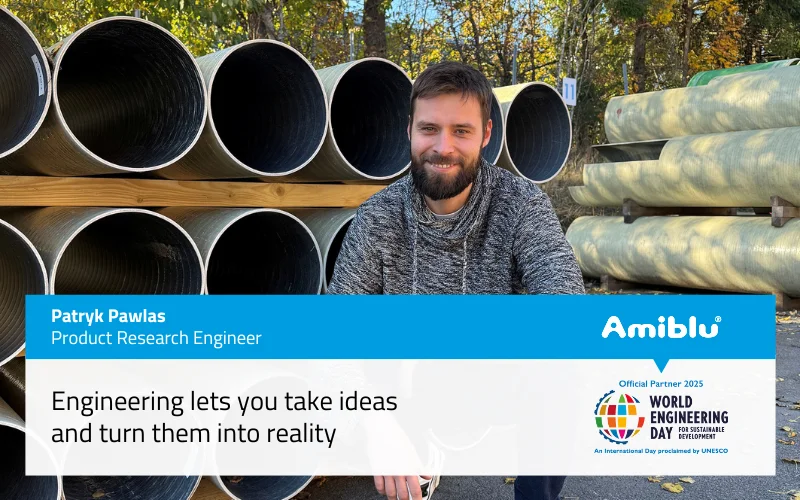
Engineering lets you take ideas and turn them into reality
Interview with Patryk Pawlas, Product Research Engineer at Amiblu Technology
What first drew you into engineering – and why product research in particular?
What drew me into engineering was the opportunity to solve real-world problems and create solutions that make a difference in people’s everyday lives. I’ve always enjoyed working at the intersection of business and production- understanding both the technical side and the practical needs of customers. Product research combines these aspects perfectly – it’s about using technical knowledge and creativity to develop better, more sustainable products that improve infrastructure and protect the environment.
What does your typical workweek look like?
It’s hard to describe a typical workweek, as my role at Amiblu involves a wide variety of tasks – from solving production challenges and developing new designs, to visiting our factories, working with our Laboratory Team on testing and validation, and collaborating with suppliers, customers and Amiblu teams around the globe.
What is the biggest challenge in developing GRP pipes?
The biggest challenge in developing GRP pipes is finding the right balance between performance, sustainability, cost, and customer requirements. Every improvement in strength or durability can affect production efficiency or material use, so it’s all about optimization – designing pipes for generations that are reliable, long-lasting, energy-efficient, and environmentally responsible, while also meeting our customers’ specific needs at an acceptable price.
Can you share a project that really tested your engineering skills – and what you learned from it?
It is hard to point out just one project, because in R&D, every challenge tests your engineering skills in different ways. Many of them require a combination of technical knowledge, creative problem-solving, and teamwork. Through these experiences, I’ve learned that collaboration and communication are just as important as technical expertise. Working closely with production teams, suppliers, and customers always brings new perspectives and helps develop better, more reliable solutions.
What makes GRP such valuable material for sustainable and resilient water infrastructure compared to traditional alternatives like steel and concrete?
The most sustainable pipes are those that, once installed, do not need to be replaced for decades – and that’s exactly what GRP pipes offer. They provide an exceptional balance of durability, light weight, and corrosion resistance. Compared to traditional materials like steel and concrete, GRP pipes require less energy to manufacture and install, have a longer service life, and are virtually maintenance-free. This combination of mechanical performance and environmental efficiency helps build infrastructure that is both resilient and environmentally responsible.
Water is one of the most precious resources in the world. How do you see the role of engineers in securing reliable, safe, and sustainable water infrastructure for future generations – and how does your own work at Amiblu contribute to the UN Sustainable Development Goals?
Engineers play a key role in ensuring that future generations have access to safe and sustainable water systems. For me, it’s about creating solutions that are not only efficient today but also long-lasting and environmentally responsible. At Amiblu, we focus on developing and improving pipe technologies that help reduce our environmental footprint. In this way, our work directly contributes to global goals for clean water, sanitation, and sustainable infrastructure, supporting a more resilient and sustainable future.
If you had one message for young people considering engineering – what would it be?
Engineering lets you take ideas and turn them into reality, solving real-world problems and making people’s lives better. It is not just about making calculations – it’s about understanding how things work and finding smarter ways to make them work. The best part is that it’s also fun and rewarding, because you get to see your ideas come to life. Stay curious, be creative, and keep exploring – the more you learn, the more interesting the journey becomes.

