GRP pipes with Hobas centrifugal casting technology
Our promise: a solid sewer upgrade for solids-free wastewater

Amiblu pipes produced with the Hobas centrifugal casting technology are made of chopped glass fiber, thermosetting resins (e.g. unsaturated polyesters or vinyl ester resins), minerals, and silica sand. The pipes are circular with an even outer diameter.
Amiblu pipes with Hobas technology are produced by centrifugal casting in a 100 % computer-controlled process. The manufacturing machine’s arm feeds all raw materials – chopped glass fibers, thermosetting plastics (unsaturated polyester or vinylester resins), and reinforcing agents – into a fast-rotating mold. Layer by layer, in a predefined process, the pipe wall is built up from the outside inwards. The material quantities inserted by the machine are monitored and compared to the desired design values in order to assure that each product is fully traceable with respect to its raw material types and quantities. Once all raw materials have been inserted into the mold, the speed of rotation is increased. High centrifugal forces of up to 75 g press the materials against the mold wall and condense them to a maximum, creating a high quality, very solid and void-free pipe wall. Cold water is used to cool the mold and after the pipe is removed, the pipe ends are trimmed and beveled. Finally, a coupling is mounted onto one end of each pipe.
The centrifugal casting process ensures that the pipes are circular, the wall thickness is uniform over the entire length at exact outer diameter, and the material displays a high longitudinal compressive strength that is particularly important for jacking. Thanks to the three-dimensional chemical bonding of the thermosetting resin, the pipe retains its stability even in very warm environments. The sandwich construction of the wall also ensures that the pipes can withstand high loading without any trouble and enables the pipe’s strength to be customized to suit the specific load directions required.
| Main materials | resin, glassfibers, sand |
| Operating temperature | -50 °C to +70 °C, higher temperatures may be considered for individual projects |
| Standard lengths | 6 and 3 m, other lengths on request |
| Pressure range | PN 1-24 |
| Corrosion protection | none needed, as materials used are inherently resistant to corrosion |
| Hydraulic roughness | k = 0.01-0.016 mm (Colebrook-White) |
| Water jetting resistance | tested according to DIN 19523 |
*As currently manufactured and distributed by Amiblu for European markets. For the full range of products with Hobas technology please refer to the Hobas website www.hobas.com.
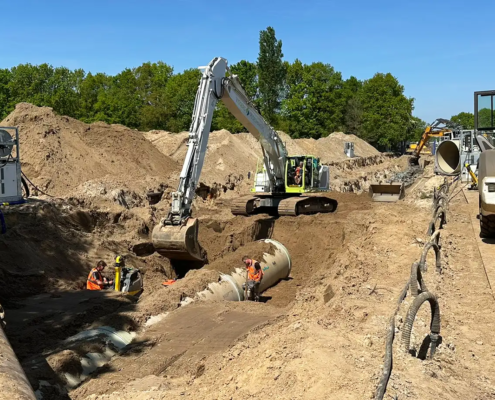 https://www.amiblu.com/wp-content/uploads/Stormwater-drainage-GRP-jacking-pipes-Gender-Veldhoven-1.webp 917 1920 Sabrina Waldner /wp-content/uploads/logo-amiblu-white.png Sabrina Waldner2026-04-07 09:25:042026-04-07 09:25:04Large-diameter GRP pipes strengthen flood protection in Veldhoven
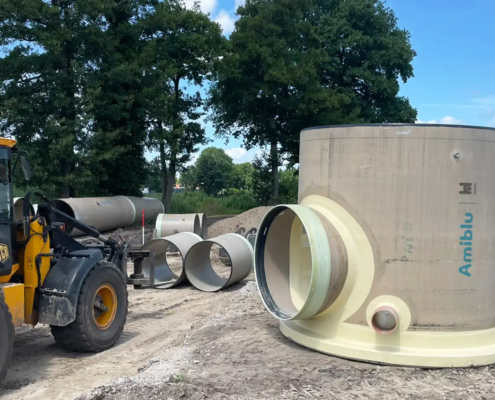 https://www.amiblu.com/wp-content/uploads/GRP-sewer-system-Lunteren-NL-1.webp 917 1920 Sabrina Waldner /wp-content/uploads/logo-amiblu-white.png Sabrina Waldner2026-03-26 10:33:012026-03-26 10:34:15Future-ready GRP sewer infrastructure drives business growth in Lunteren
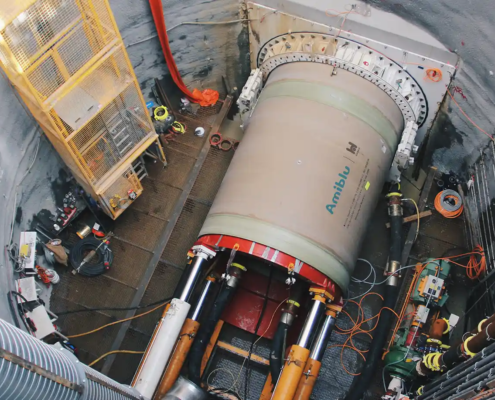 https://www.amiblu.com/wp-content/uploads/Amiblu-Pipe-Jacking-North-Yarra-Main-Sewer-Melbourne-AUS.webp 917 1920 Sabrina Waldner /wp-content/uploads/logo-amiblu-white.png Sabrina Waldner2025-07-22 13:25:202025-07-24 08:52:35Amiblu GRP Secures Historic Sewer Beneath Melbourne
© Amiblu Holding GmbH, 2026