
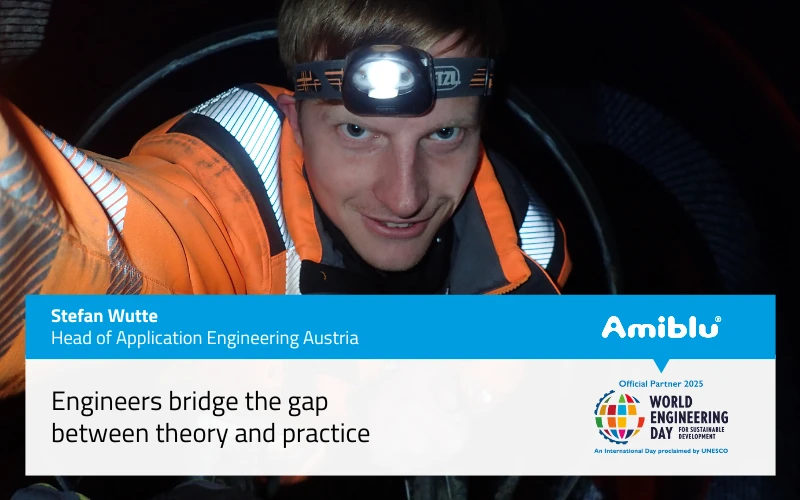
Engineers bridge the gap between theory and practice
Interview with Stefan Wutte, Head of Application Engineering at Amiblu Austria
Stefan Wutte has been part of Application Engineering in Austria since 2009, serving as a trusted expert and problem-solver for our customers for over 16 years.
In his early years, he helped design machines for the production of the first centrifugally cast DN 3000 GRP pipe in Poland. His job quickly changed from pure design work to additional responsibilities such as site supervision and field service activities. Since 2013, he holds the position of Head of Application Engineering at Amiblu in Austria.
In your view, what does it mean to be an engineer in our industry, and how do engineers act as problem-solvers and innovators?
For me, engineering in pipeline construction is much more than simply applying technical standards—engineers play a key role in shaping sustainable infrastructure. Engineers are problem-solvers in the best sense: we combine technical expertise with creativity to develop solutions that not only work, but are also economical, ecological, and future-proof. Especially in times of climate change and increasing demands for resource efficiency, innovation is essential.
Whether it’s optimizing installation techniques, selecting durable materials, or integrating digital technologies—engineers are often the drivers of progress. I see our role as the bridge between theory and practice, between vision and implementation.
Do you see engineers as advocates of sustainability, and if so, in what sense?
Yes, I definitely see engineers as key advocates of sustainability – on multiple levels. Our decisions directly influence how resource-efficient, durable, and environmentally compatible construction projects are. In civil engineering, this means, for example, choosing sustainable materials, developing energy-efficient methods, and planning systems that will function reliably for generations.
But it’s not just about technology – it’s also about attitude: engineers have a responsibility to ensure that solutions are not only economical and safe, but also ecologically and socially viable. We can drive innovation and prioritize solutions that reduce the carbon footprint, promote the circular economy, and improve quality of life. Sustainability is therefore not an add-on, but an integral part of our work.
Have there been moments when your technical skills and ingenuity, or those of your team, made all the difference in a project’s success?
Basically, that’s the case every day. Our products are not bought off the shelf at a hardware store – we deliver engineering solutions for complex projects along with the corresponding products and services.
What do you like most about your work at Amiblu, and what does a typical working day look like?
What I like most is that there really isn’t a “typical” workday, because every day is different.
One day I’m in the office in Klagenfurt calculating pipe statics from all over the world, in between numerous online meetings with colleagues. Another day I’m on a hydropower construction site in Austria, advising the construction company on installation and carrying out inspections of the pipelines. And the following week I might have business development meetings with sales colleagues in Asia-Pacific.
What has been your best moment with colleagues so far? What are you particularly proud of?
There have been so many wonderful and special moments over the years that listing them all would go far beyond this interview. I think when I retire, I could write a book about them. I am especially proud of my team and the consistently great collaboration. It just works.
How do you see your future at Amiblu?
I see my future at Amiblu as an exciting journey with many development opportunities – past and still to come. I am particularly drawn to the international focus and the opportunity to contribute to pioneering, sustainable infrastructure projects that truly make a difference.

